
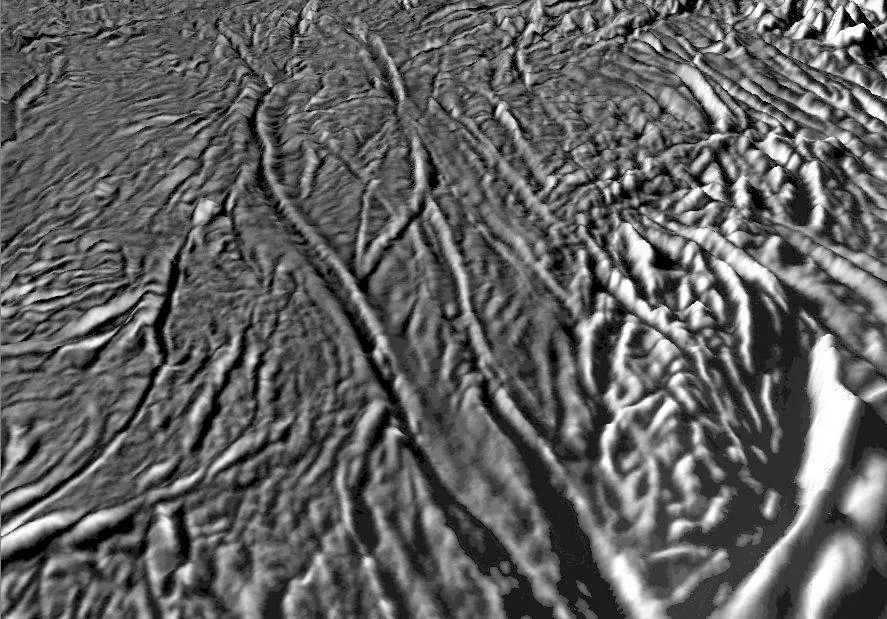
Advanced Space conducted a feasibility study for a non-profit organization that investigated the functions, cost, and complexity of three major components for a low-cost mission to Saturn’s moon Enceladus: (1) the entire trajectory set for a spacecraft to follow, (2) the navigation architecture, including both in-space and ground-based navigation, and (3) a low-cost ground system to support the mission. The mission’s science goal is to determine if biological signatures of life exist there. The spacecraft, named Encelascope, would collect its data by flying through the plumes that are erupting from the “Tiger Stripes” that appear on Enceladus’ southern latitudes observed spewing a stream of tiny particles into space, apparently from an underground ocean. The science would require that the spacecraft pass through the Tiger Stripes’ plumes as low as possible, down to 1-20 kilometers above Enceladus’s surface, and the science phase would last approximately one year.
The mission would consist of several phases: Earth Escape, which would put the spacecraft on the way toward its interplanetary transfer; Interplanetary Transfer, which would consist of the long trip out to Saturn, including flybys of Venus and Earth to gain energy; Saturn Orbit Insertion, entering the ringed planet’s gravity influence between the F and G rings; Saturn Moons Tour, which would allow the spacecraft to capture up-close images of multiple moons and also would allow the spacecraft to reduce its speed just enough to enter a useful science orbit around Enceladus; Enceladus Orbit Insertion, capturing into an orbit about Enceladus and lowering to the science orbit; and Science around Enceladus, performing autonomous operations with ground supervision and guidance to collect the scientific observations. The total flight time would be about 15 years: approximately 14 years for the transfer from Earth to Saturn and around its moons, then a year of science.
This mission has set the record within the industry for how slowly a probe can fly through the Tiger Stripe plumes in order to collect samples with the least amount of violent energy that could destroy the samples. The relative velocity of the spacecraft and the Tiger Stripe plumes is only 185 m/s – much slower than a commercial airliner.
The work consisted of three parts:
- Mission Design: Determine the delta-V necessary to get from low Earth orbit (LEO) to Enceladus based on a launch around 2027 and arrival by 2040.
- Navigation: Determine how to navigate the spacecraft throughout the mission without using (or using as little as possible) ground-based navigation.
- Ground Segment: Figure out how to communicate with a spacecraft at Saturn without using NASA’s Deep Space Network (DSN).
The Advanced Space team optimized the interplanetary transfer in NASA’s Evolutionary Mission Trajectory Generator (EMTG), then developed a higher-fidelity trajectory in Copernicus. Based on a launch in 2026, this planned mission design resulted in a Saturn arrival in late 2035.
Most missions to the outer solar system rely on Earth-based navigation solutions. Advanced Space designed Encelascope to navigate using visual “landmarks” closer to the mission’s flight, including Jupiter and Saturn, the Saturnian moons, and stars that would become visible over Enceladus’s horizon.
Another challenge to overcome was communication with the spacecraft without using DSN. We addressed this problem in part by combining multiple antennas (~30 4.5-meter apertures) in a phased array, setting up multiple smaller antennas to replicate the performance of a single 34-meter-aperture antenna used by DSN. These multiple antennas would handle downlinks from the spacecraft while a single 7-13-meter antenna would send commands up to the spacecraft. We also determined that the spacecraft would communicate with the ground via Ka-band radio to ensure the best data rate, spacecraft antenna gain, maximum useful communication distance, and days with available communication range.
Based on the trajectories we examined, and the other factors mentioned above, Advanced Space determined that this end-to-end Enceladus mission could be flown for a 2040 arrival for a low cost.