
Advanced Space supported the United Arab Emirates’ Mars mission (EMM, also known as Hope and Amal) by working directly with the UAE engineers, the scientists, the engineers, and many others to build the mission design, science orbit design and implementation, launch targets, science collection concept of operations, and navigation support. The prime partner on this mission is CU Boulder’s Laboratory for Atmospheric and Space Physics (LASP). This mission’s science goals are related to collecting diurnal, temporal, and global observations of Mars from the surface to the exosphere. Advanced Space iterated with the science team to build observation rules and cadences to satisfy science requirements and create science products. Advanced Space worked closely with the team to define the ConOps to be robust to the presence of DSN scheduling and navigation uncertainty. During that process, Advanced Space built a science verification tool to be used during the development phase, and it has been adapted for use during the operations phase. This mission is in-flight, and the tools created for science verification are still in use by the operations team.
The spacecraft was launched on a Mitsubishi Heavy Industries H-IIA rocket. The spacecraft was launched into Earth orbit at the exact time to align it with the planetary transfer, after which the upper stage reignited to accelerate the spacecraft on its trajectory toward Mars at a velocity of 11 km/s. Once the trans-Mars injection orbit began, the trajectory was refined throughout its journey by a series of trajectory correction maneuvers (TCMs). The first two TCMs were performed during this phase. Further TCMs were performed to keep the spacecraft on track toward its destination.
During the Mars Orbit Insertion (MOI) phase, communication between the ground and space segments was focused on safely entering a capture orbit at Mars. Nearly half of the fuel was spent to slow down the spacecraft enough for MOI. The maneuver itself lasted approximately 30 minutes and reduced the speed of the spacecraft from over 121,000 km/h to approximately 18,000 km/h.
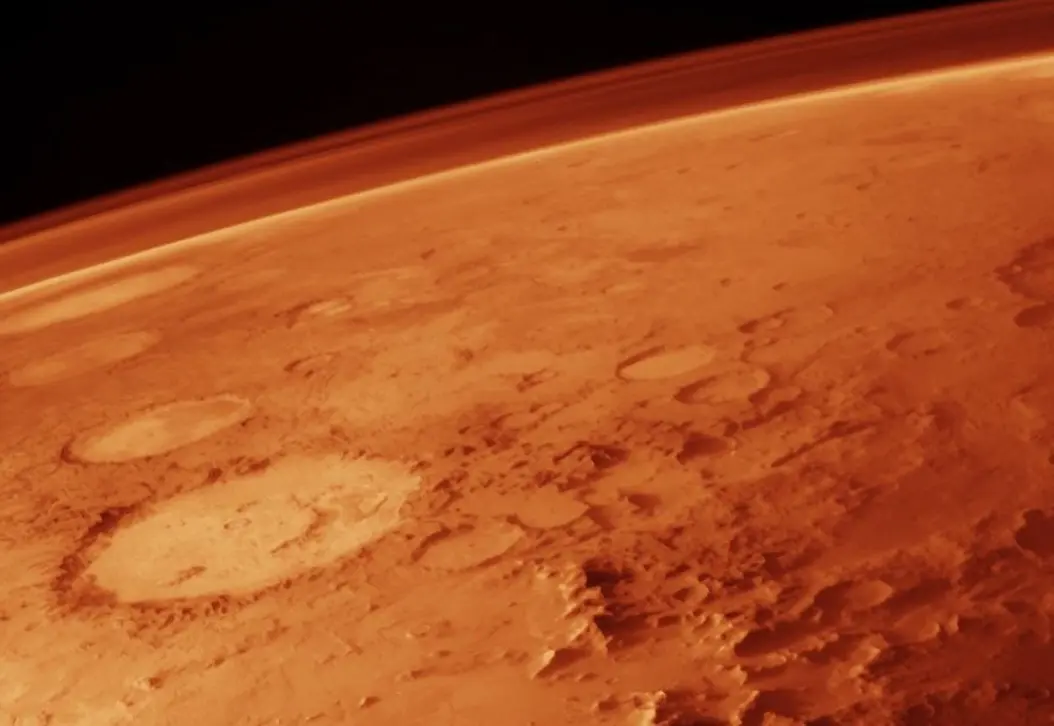
The Capture Orbit – an elliptical orbit lasting 40 hours, took the spacecraft on an orbit with a periapsis as close as 1,000 km above Mars’ surface and an apsis as far as 49,380 km. In the Capture Orbit, the first image of Mars from the science instruments was taken and transmitted to the Mission Operation Center (MOC) on February 10, 2021. Since then, additional maneuvers were performed to move the observatory into its science orbit. Daily contact now occurs through the DSN, enabling a quick turn-around of command sequence uploads and telemetry receipt.
Advanced Space worked very closely with the team to define an extended mission that performed a dozen targeted flybys of Deimos: the second spacecraft ever to fly by Deimos after Viking 2 did so in 1977.