
Advanced Space is Heading Back to the Moon for NASA with New Mission: CAPSTONE 02
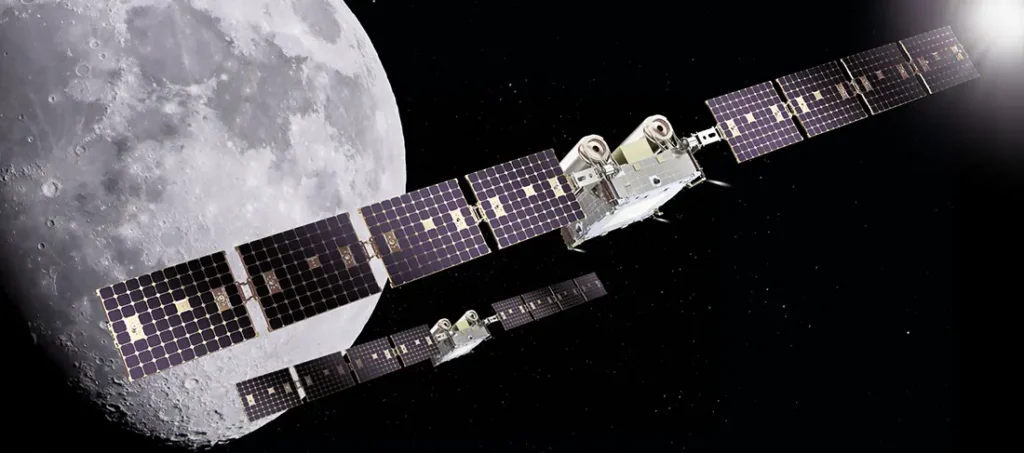
Advanced Space Announces the new CAPSTONE 02 Mission for NASA to Deploy Two Spacecraft to Advance Autonomous Navigation and Rendezvous and Proximity Operations in Cislunar Space.
WESTMINSTER, CO, 24 July 2026 – Advanced Space, a leading space technology solutions company supporting the sustainable exploration, development, and settlement of space, is pleased to announce CAPSTONE 02, a new two-spacecraft mission being developed in partnership with NASA along with Terran Orbital, a Lockheed Martin Company, as the bus provider.
Building on the success and lessons learned from the original CAPSTONE mission currently operating around the Moon, CAPSTONE 02 is designed to advance rendezvous and proximity operations (RPO) and autonomy capabilities in multibody cislunar orbits. The mission is planned to be ready to launch in 2027. The demonstration will fly two identical spacecraft of approximately 400 kilograms (882 pounds) from Terran Orbital. As operations at the Moon scale in quantity, foundational technologies such as autonomous navigation will be critical to enable safe and long-term operations.
RPO involves the close-range maneuvering of spacecraft to approach other spacecraft or objects. These capabilities are important for lunar orbit rendezvous between crewed transportation vehicles and lunar landers, on-orbit refueling of landers or other spacecraft, and logistics to extend mission lifetimes and enable reusable systems. RPO can enable inspection, servicing, and repair of critical space infrastructure in cislunar space and other long-term needs such as servicing operations.
“With CAPSTONE 02, we are taking the next step toward routine, resilient operations in cislunar space,” said Bradley Cheetham, President & CEO of Advanced Space. “By maturing autonomous rendezvous and proximity operations in this complex environment, we are directly enabling the future of lunar exploration, development, and long-term presence. CAPSTONE 02 can reduce risk for Moon Base, Artemis and every lunar mission that follows.”
Conducting Operations in the Cislunar Environment
Cislunar space refers to the region between the Earth and the Moon, including orbits around the Moon itself. This domain is a critical operational environment for future human and robotic activities, including lunar surface missions, logistics, communications, and infrastructure to support sustained exploration.
Orbits in the cislunar region are shaped by the gravitational influence of multiple celestial objects—primarily Earth and the Moon. These orbits exhibit complex, non-intuitive dynamics that differ significantly from traditional two-body orbital mechanics around the Earth, demanding advanced navigation, guidance, and operations capabilities.
CAPSTONE 02 will operate in this challenging environment to demonstrate, test, and refine technologies and operations concepts needed to safely and efficiently conduct missions in support of Moon Base and future commercial activities.
Building on the Success of CAPSTONE™
The original CAPSTONE, a microwave oven–sized, 55-pound CubeSat, launched on June 28, 2022, has been operating around the Moon since November of that year. As the first commercially owned and operated spacecraft to orbit the Moon, CAPSTONE has surpassed all primary mission objectives and continues to deliver value well beyond its original 18-month design life. The CAPSTONE team was able to conduct a groundbreaking suite of new, high-priority experiments that addressed NASA-identified technology shortfalls and increased the Technology Readiness Level (TRL) of flight and ground technologies that could support future efforts in cislunar space under NASA’s Artemis program. In partnership with NASA’s Goddard Space Flight Center and Terran Orbital, the CAPSTONE Experiment Extension Program (CEEP) has demonstrated critical capabilities in spacecraft autonomy, cislunar navigation, and interoperable, standards-based communications, technologies essential to securing and extending American leadership in lunar exploration and beyond.
CAPSTONE concluded its mission for NASA in June 2026. It served NASA reliably for four years with its innovative software-based demonstrations. CAPSTONE 02 will replace and augment that capability as NASA completes its utilization of the commercially owned and operated software-defined lunar platform.
CAPSTONE 02 directly leverages all the knowledge and expertise Advanced Space has gained from operating a satellite in lunar orbit. The new mission uses operational experience and technical lessons from the original CAPSTONE to refine mission design for operations in multibody cislunar orbits, enhance autonomy algorithms for navigation and RPO, and demonstrate more advanced operational concepts with two cooperating spacecraft for long-term lunar operations.
“CAPSTONE demonstrated what is possible in cislunar operations with small satellite technology and rapid mission timelines. The CAPSTONE 02 mission will push that envelope even further by demonstrating RPO in a three-body orbit, enabling demonstration of cislunar communications architectures, and proving autonomy capabilities that future lunar missions will depend on,” said Alec Forsman, CAPSTONE 02 Program Chief Engineer.
Advanced Space and NASA are working with numerous partners to enable the CAPSTONE 02 mission. In addition to spacecraft design and manufacturing, Terran Orbital will provide mission operation and launch integration services. Stellar Exploration will deliver a chemical propulsion system enabling lunar insertion and RPO maneuvering capabilities. The communications system, including direct-to-Earth communications and crosslink communications, is developed and provided by the Utah State University Space Dynamics Laboratory. Lawrence Livermore National Laboratories (LLNL) will provide integrated optical payloads, including LLNL-patented monolithic optics. CAPSTONE 02 will also fly NASA’s Compact Electron Proton Spectrometer (CEPS) instrument demonstrating space weather radiation forecasting, and three NASA-developed navigation software payloads.
CAPSTONE, the first commercial satellite to operate at the Moon, and now the future CAPSTONE 02, are setting a precedent for how the U.S. commercial space sector can accelerate exploration, de-risk future programs, and expand American presence in cislunar space by supporting NASA’s Moon Base initiative and Artemis program.