
Advanced Space Completes Critical Design Review Milestone for CAPSTONE 02
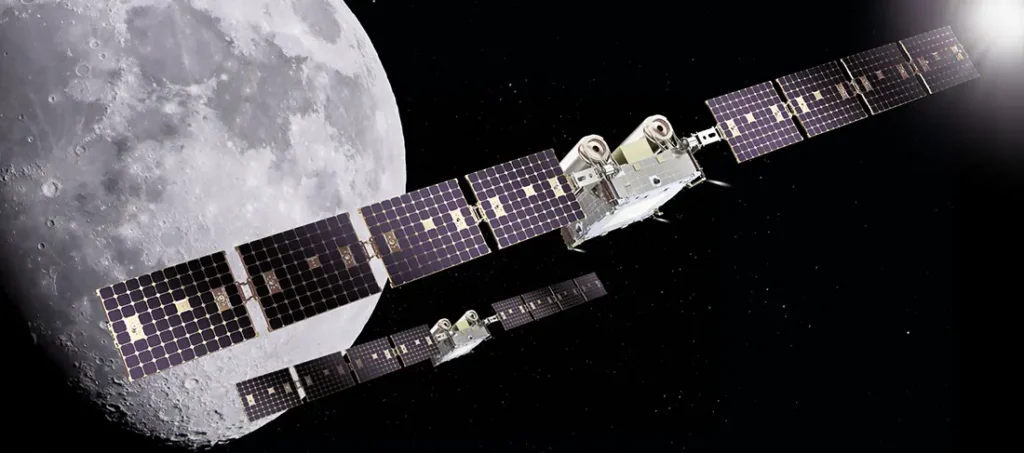
Colorado-based company Advanced Space is the owner and operator of CAPSTONE 02.
WESTMINSTER, CO, 25 August 2026 – Advanced Space announced the successful completion of the Critical Design Review (CDR) for NASA’s CAPSTONE 02 mission.
As prime contractor for CAPSTONE 02, Advanced Space is leading the development of the mission, which will help advance key cislunar capabilities to support NASA’s Artemis program, Moon Base, and future deep space missions.
The successful CDR marks a major milestone for CAPSTONE 02, confirming the mission design is mature and ready to move into the next phase of development, integration, and testing. Advanced Space was honored to host its key partners at its Colorado headquarters, namely NASA, Terran Orbital, Lawrence Livermore National Laboratory, Space Dynamics Laboratory, as well as other participants. The review’s success is a testament to the commitment and professionalism of all the partners.
Targeted for launch in 2027, CAPSTONE 02 will use two small spacecraft in lunar orbit to demonstrate rendezvous and proximity operations, autonomous navigation, and cislunar communications capabilities while characterizing the radiation environment near the Moon. The mission is designed to inform future lunar exploration architectures and support the development of scalable orbital infrastructure in cislunar space.
Building on the success of NASA’s original CAPSTONETM mission, CAPSTONE 02 expands the scope of in-space demonstrations, from orbit validation to increasingly sophisticated operational concepts. CAPSTONE became the first U.S. commercial mission to the Moon and the first spacecraft to operate in a near rectilinear halo orbit around the Moon, a nearly stable orbit shaped by the combined gravitational influence of Earth and the Moon.
“Successful completion of CAPSTONE 02’s Critical Design Review is an important step forward for the mission and showcases the dedication of our team and partners,” said Bradley Cheetham, President & CEO at Advanced Space. “CAPSTONE 02 is designed to demonstrate technologies and operational approaches that will help enable the future of cislunar infrastructure, lunar exploration, and sustained operations in deep space.”
CAPSTONE 02 will demonstrate advanced relative navigation techniques for rendezvous and proximity operations in cislunar space, techniques that are more complex than those typically used in low Earth orbit. These capabilities are relevant to future mission scenarios in which astronauts may dock with lunar landers in cislunar orbit for transfer to and from the lunar surface.
The mission will fly two identical spacecraft, approximately 400 kilograms each. By allowing each spacecraft to alternate between “chaser” and “target” roles, the mission will test a wide range of navigation and operations scenarios under the unique environmental conditions of cislunar space.
To support these demonstrations, CAPSTONE 02 will use a combination of ground tracking measurements, optical sensors, and celestial observations to enable one spacecraft to locate and rendezvous with the other. The mission will also serve as an operational testbed for three NASA-developed navigation software suites, which will collect data during the mission’s low-energy transfer trajectory from Earth to beyond the Moon and into lunar orbit.
In addition, the spacecraft will carry an optical imaging payload from Lawrence Livermore National Laboratory to support navigation demonstrations and capture imagery of the Moon.
The mission is funded by NASA’s Human Spaceflight Mission Directorate with support from the agency’s Research and Technology Mission Directorate and is managed by Small Spacecraft & Distributed Systems at NASA’s Ames Research Center in California’s Silicon Valley.
Advanced Space continues to play a leading role in mission design, navigation, and operations for complex missions beyond Earth orbit. CAPSTONE 02 reinforces the company’s commitment to delivering innovative, mission-focused solutions that reduce risk and expand the boundaries of exploration.